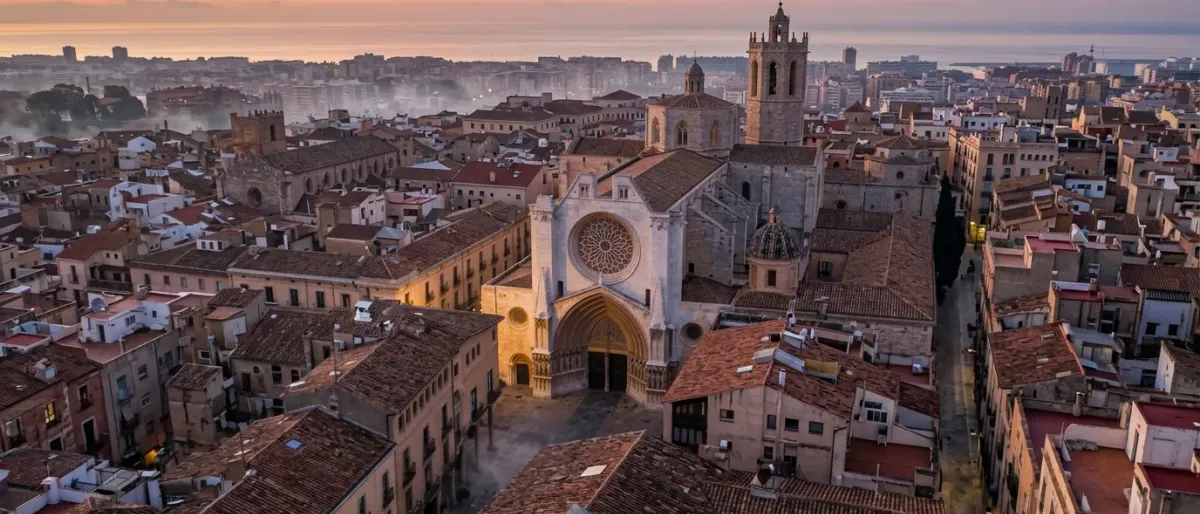
Tarragona vs Barcelona: the real cost of living compared
Same sun, same sea, same Catalan taxes — but rent at a 1-to-3 ratio: around €9/m² in Tarragona province versus ~€30/m² in Barcelona city (idealista data, 2026). For a Nordic remote worker or semi-retiree, choosing Tarragona over Barcelona frees up hundreds of euros a month without changing the climate. Here's the honest comparison, item by item — written by someone who made this exact choice and lives on the Costa Daurada.
Tell people in Stockholm or Copenhagen you're moving "near Barcelona" and everyone nods. Say "Tarragona" and you get blank stares. That asymmetry is precisely the opportunity: an hour by train from Barcelona sits a Roman-heritage provincial capital with golden beaches, 2,900 hours of sun a year — and prices that recall Scandinavia a generation ago. Let's compare properly.
Housing: the item that decides everything
In practice, for an 80 m² flat: roughly €700-900 in Tarragona versus €2,000-2,400 inside Barcelona — if you can even secure one, given Barcelona's brutal rental competition. The data is public: idealista's price reports for Catalonia and the Housing Ministry's official SERPAVI rental index let you verify street by street. One honest caveat: Tarragona recently posted Catalonia's steepest rise (+21% year-on-year) — the gap is slowly narrowing, which argues against waiting a decade.
Buying follows the same logic: Tarragona's square metre costs a fraction of Barcelona's, under identical taxation (Catalan ITP applies to both — see our guide to buying property in Spain).
The full match, item by item
| Criterion | Tarragona | Barcelona |
|---|---|---|
| Rent, 80 m² | ~€700-900 | — ~€2,000-2,400 |
| Pace of life | Human-scale city (~140,000), zero stress | — Metropolis: energy, but crowds and noise |
| Local job market | — Limited (industry, port, tourism) | Southern Europe's economic hub |
| Remote work / independents | Ideal: low costs + fibre + calm | Startup ecosystem, dense networking |
| Airport | Reus (low-cost, seasonal) + BCN ~1h away | El Prat: daily Nordic connections year-round |
| Beaches | Costa Daurada: golden sand, shallow water, families | Busy urban beaches |
| International community | Present and accessible | Huge, but diluted in the metropolis |
| Winter feel | Quiet, sunny, local life continues | Livelier — at metropolitan prices |
The train question: Barcelona stays within reach
The argument that converts most fence-sitters: living in Tarragona doesn't mean giving up Barcelona. Regional and mainline trains (Renfe) link Tarragona to central Barcelona in about 1h-1h20, and the Camp de Tarragona AVE station puts Madrid at 2h30. The typical pattern among independents here: the metropolis for a client meeting or networking event, the Costa Daurada for everything else.
Who should choose what?
- Choose Tarragona if…
You work remotely for a Nordic employer, live on a pension or independent income, want space for a family, or prefer your housing budget to fund life rather than walls. That's the profile of most Northern Europeans I meet here.
- Choose Barcelona if…
Your income depends on a qualified local job, your sector runs on physical networking (startups, creative, finance), or big-city energy is non-negotiable for you.
- The smart middle ground: the Tarragona-Sitges axis
Vilanova, Sitges, Torredembarra, Altafulla: the coast between the two offers gradations of price and atmosphere — the closer to Barcelona, the steeper the square metre.
Taxes, procedures, healthcare: identical — same autonomous community. NIE, empadronamiento, SIP card and the Renta follow the same rules in Tarragona as in Barcelona. One practical difference: cita previa waiting times, usually far shorter in Tarragona — an under-appreciated advantage covered in our NIE guide.
Your relocation then follows the classic path: empadronamiento at the town hall, NIE and registration certificate, and if you keep your Nordic employer, the four workstreams of remote work from Spain — including the 183-day question that winter residents should settle early.
FAQ
How much cheaper is rent in Tarragona than Barcelona?
Can you live in Tarragona and work in Barcelona?
Is Tarragona suitable for Nordic families?
Do administrative procedures differ between the two cities?
Is everyday life (beyond rent) also cheaper in Tarragona?
Further reading
Tempted by the Costa Daurada?
I chose Tarragona over Barcelona — and I'm happy to tell you why first-hand, with real numbers and the addresses that matter.
Let's talk about your move