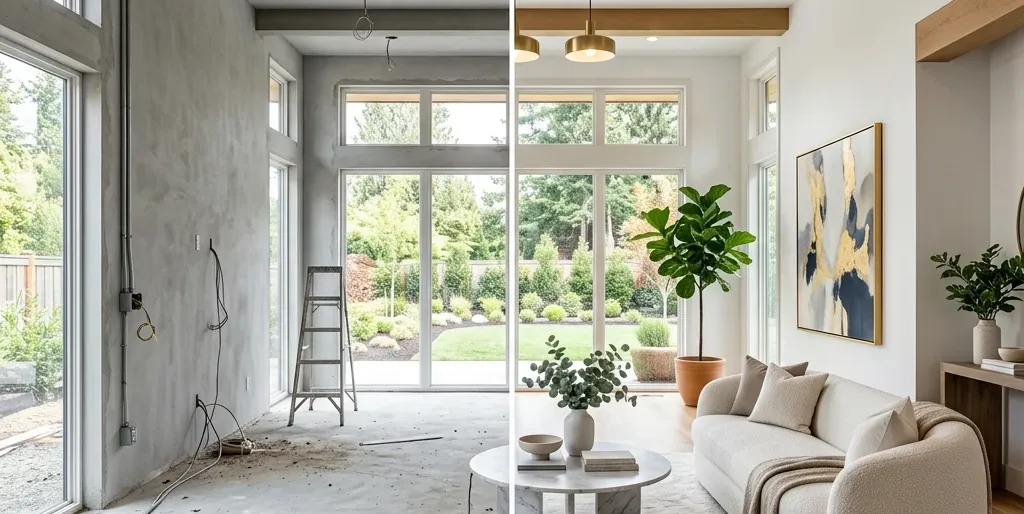
Digital home staging: does it really deceive buyers?
Digital home staging, virtual staging — the technique itself isn't deceptive. What matters is what you choose to modify and whether you disclose it clearly. Legal framework in Belgium and Spain, legitimate vs misleading uses, and what a professional quote must include.
What exactly is digital home staging?
Digital home staging — also called virtual staging — is the process of digitally modifying real estate photos after the shoot. An empty living room becomes a furnished space. A bedroom with a 1980s wardrobe gets a contemporary dressing.
This differs from physical home staging, where actual furniture is rented or purchased to decorate the property before photos are taken. Digital staging is faster, cheaper, and can be applied retroactively to existing photos. Prices typically range from €15 to €90 per photo depending on the provider's quality.
In the markets where I work — Liège, Brussels, Namur, Luxembourg on the Belgian side, and Tarragona, Salou, Barcelona on the Spanish side — the practice has become widespread since 2022. The reason: empty properties sell less easily. Buyers struggle to visualise an empty space, especially when searching from abroad.
What it doesn't change — and never should
A serious digital home staging provider never modifies:
- Surfaces — floors, walls, ceilings. A 90s kitchen tile stays a 90s kitchen tile.
- Architecture — no added windows, no moved walls, no enlarged rooms.
- Visible defects — cracks, damp stains, degraded flooring, ceiling stains. Hiding these in retouching is fraud.
- Actual natural light — a dark room stays a dark room.
- Exterior views — the parking lot view stays the parking lot view.
What can legitimately be modified: furniture (adding to empty spaces, replacing dated pieces), decorative accessories, and occasionally wall colours for illustration — provided this is clearly disclosed.
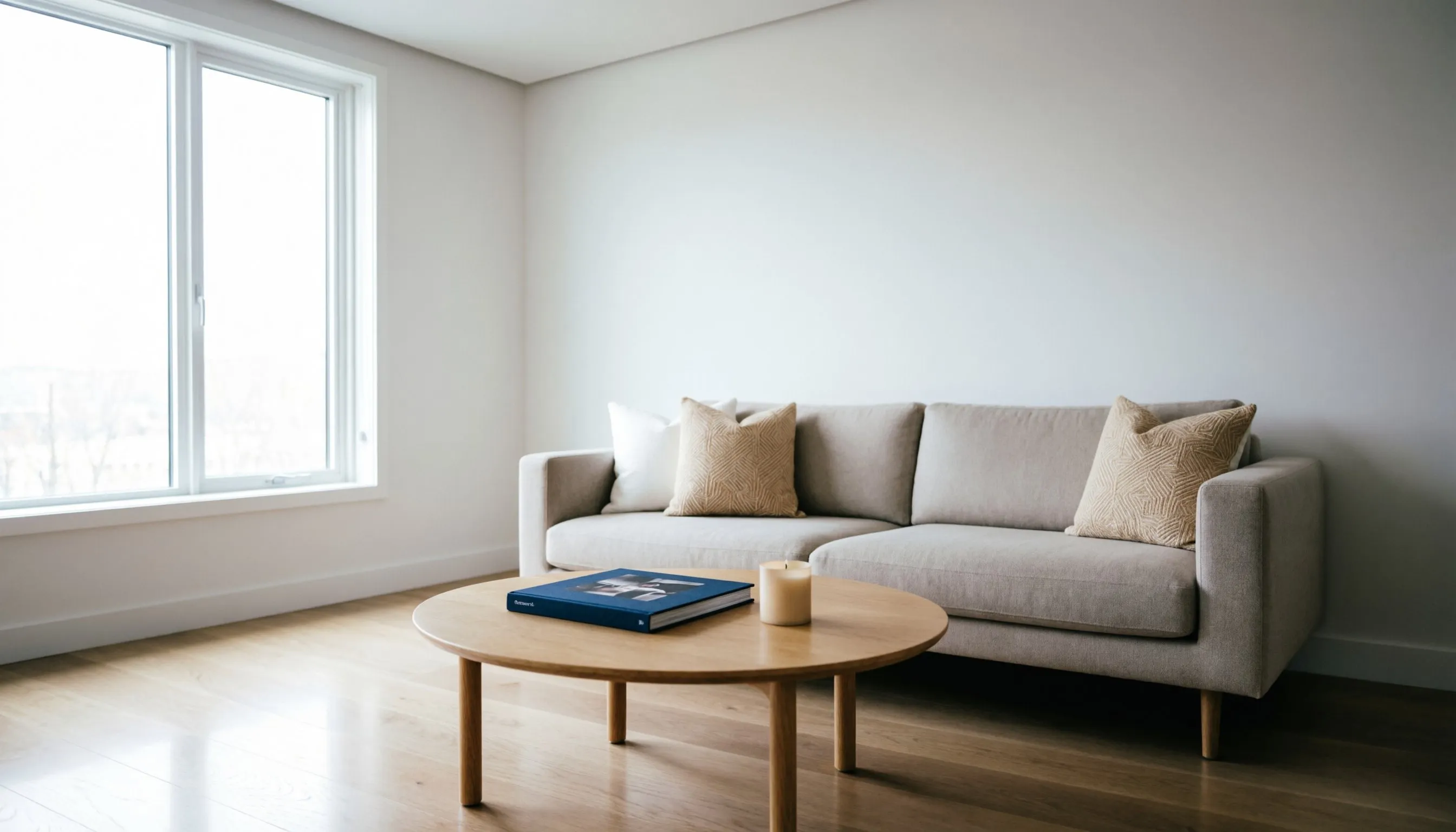
Is it legal? Regulations in Belgium and Spain
Belgium — The Belgian Code of Economic Law (art. VI.97 and following) prohibits misleading commercial practices. Real estate listing photos fall under this framework. The mention "visualisation image" or "decoration suggestion" is mandatory on every modified photo where the property doesn't match what is shown. The IPI (Professional Institute of Real Estate Agents) has recommended this practice since 2021.
Spain — The Ley de Competencia Desleal (Unfair Competition Act) and Spanish real estate sector regulations apply. On Idealista and Fotocasa, retouched photos must carry the "imagen virtual" or "fotografía editada" label. Agencies on the Costa Daurada, Tarragona and Barcelona apply this rule inconsistently — checks remain rare, but the seller's civil liability can be engaged in case of dispute.
In practice: if you publish modified photos without a clear disclaimer, you risk a complaint from the buyer after signing. The risk is low but real.
Legitimate vs misleading: the practical line
Legitimate — Furnishing a completely empty space, replacing old furniture with contemporary pieces, adding decorative accessories (cushions, plants), illustrating an alternative paint colour, removing the owner's personal items (with agreement), correcting a slight colour cast.
Misleading — Hiding cracks or damp stains, adding windows or modifying architecture, changing flooring or tiles, visually enlarging rooms, improving the view from windows, publishing without a "visualisation image" disclaimer.
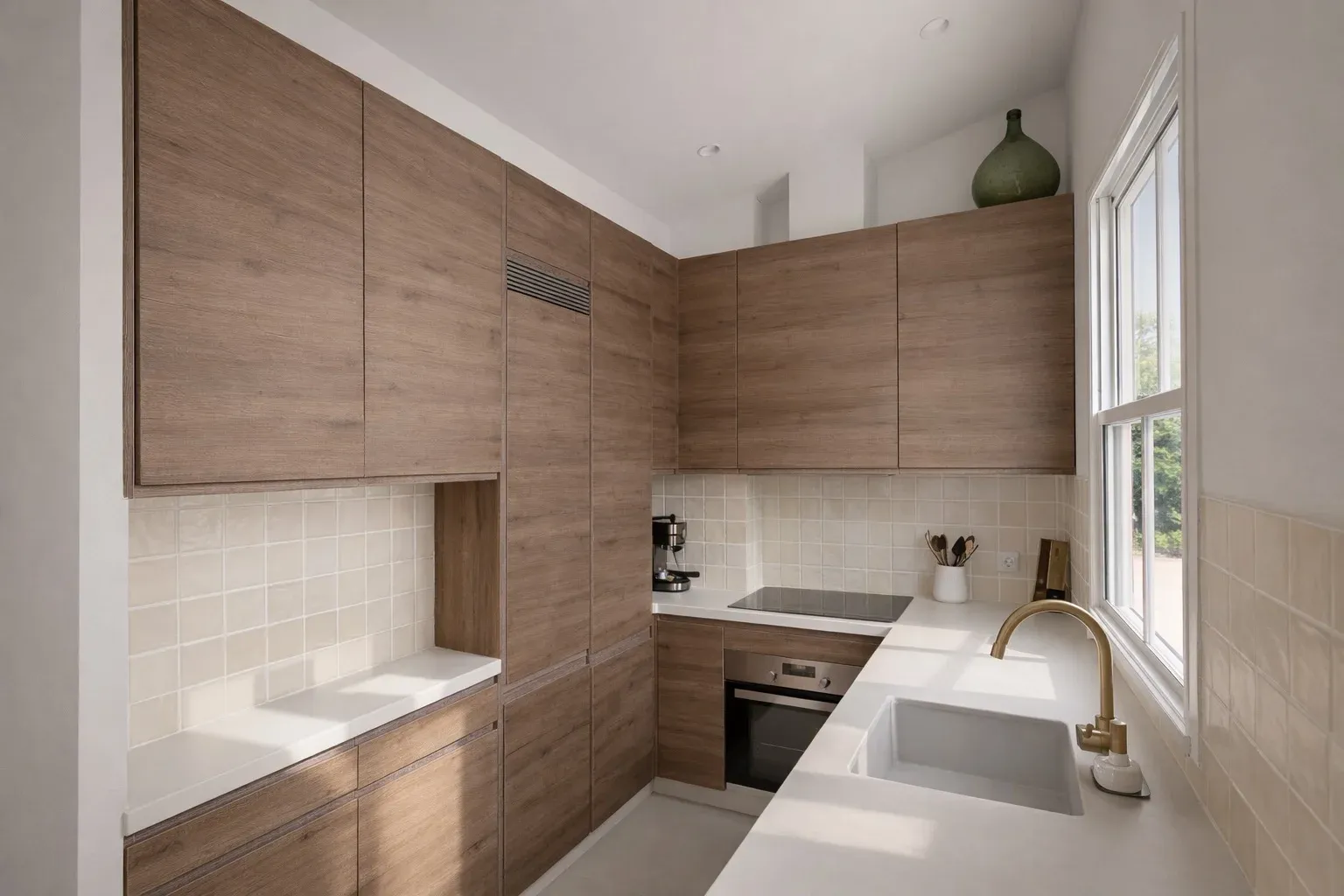
Price comparison — what the market offers
The digital home staging market in Belgium and Spain divides into three segments with very different results.
| Provider type | Price / photo | Turnaround | Quality | Legal label | Revisions included |
|---|---|---|---|---|---|
| AI platform (BoxBrownie, Styldod) | €15–30 | 24h | Variable, sometimes artificial | Rarely included | 0–1 included |
| Generalist freelance designer | €40–65 | 48–72h | Average, depends on profile | Rare, must negotiate | 1–2 included |
| Specialised real estate photo studio | €60–90 | 72h–5d | Professional, realistic, consistent | Systematic, compliant | 2–3 included |
| Full-service creative agency | €90–150 | 5–10d | High-end, editorial quality | Included | Unlimited |
AI platforms at €15–30 typically charge for each revision after delivery. A furniture replacement request = a new invoice. The actual cost for 3 photos can exceed €150.
What a serious digital home staging quote must include
- Exact number of photos to be processed
Not 'up to X' or 'approximately'. A precise count. Each additional photo must have a clear unit price.
- Type of intervention specified
Furnishing an empty space (simpler) or replacing existing furniture (more complex, often more expensive). These are not priced the same.
- Legal label on visuals
The quote must state that every delivered photo will carry a 'visualisation image' / 'imagen virtual' (ES) label. This is your legal protection as an agency.
- Guaranteed delivery deadline
Not 'within a few days'. A precise date or timeframe in business days.
- Delivered file formats
JPEG for portals (Immoweb, Idealista), high resolution for print. Pixel dimensions and maximum file weight accepted by each portal must be respected.
- Number of included revisions
If the result doesn't meet your expectations, how many corrections can you request at no extra cost? 1, 2, unlimited?
- Usage rights
Can the photos be used on all portals, in print, on social media? Some providers limit usage to a single channel or impose a duration.
- Cancellation terms
If the property sells before delivery, if the project is cancelled after approval — what happens? The quote must address these scenarios.
How to choose your digital home staging provider
Not all providers are equal. Here are the 4 criteria to check before signing.
Portfolio — A serious provider has recent before/after examples. Not generic catalogue renders. Ask to see photos of properties similar to yours (empty apartment, furnished house, studio).
Legal labelling — The provider must systematically add a "visualisation image" label on every modified photo. If they don't do this by default, it's a red flag.
Included revisions — AI platforms charge for each correction after delivery. A human provider typically includes 2–3 revisions in the price. Anything beyond should be negotiated upfront.
Local market knowledge — A provider who understands Belgian (Immoweb, Zimmo) and Spanish (Idealista, Fotocasa) portal specifications will produce visuals adapted to each platform's formats and technical constraints. Image dimensions, file sizes and maximum photo counts differ per portal.
Digital home staging vs generative AI: risks for agencies
Since 2024, generative AI tools like Midjourney, DALL-E and Adobe Firefly can create photorealistic furniture and decoration that doesn't physically exist. The temptation for some providers: rather than virtually furnishing an empty space, AI creates a space that never existed.
The problem: these images may be impossible to reproduce physically. An AI-generated sofa can have unrealistic shapes or proportions. A window can be added where none exists. Unlike a human graphic designer, AI doesn't verify architectural consistency.
For agencies, the risk is twofold:
- Legal risk — Publishing an AI-generated image that doesn't correspond to the actual property falls under Belgian and Spanish regulations on misleading commercial practices.
- Reputational risk — A buyer who visits a property and discovers the photos don't match reality instantly loses trust in the agency.
At Amory Studio, our position: digital home staging is a legitimate tool, provided it remains realistic, transparent, and limited to furnishing existing spaces. We do not use generative AI to create architectural elements that don't exist.
Frequently asked questions
Is digital home staging legal in Belgium?
What's the difference between physical and digital home staging?
How much does digital home staging cost per photo in Belgium?
Can digital home staging hide defects?
Are Belgian and Spanish buyers aware of this practice?
Does generative AI replace traditional digital home staging?
Which real estate portals accept digital home staging photos?
Further reading
Réponse sous 48h · Sans engagement
Transparent and professional digital home staging
Systematic legal labelling, realistic rendering, retouches included. Compliant with Belgian and Spanish regulations.
View services